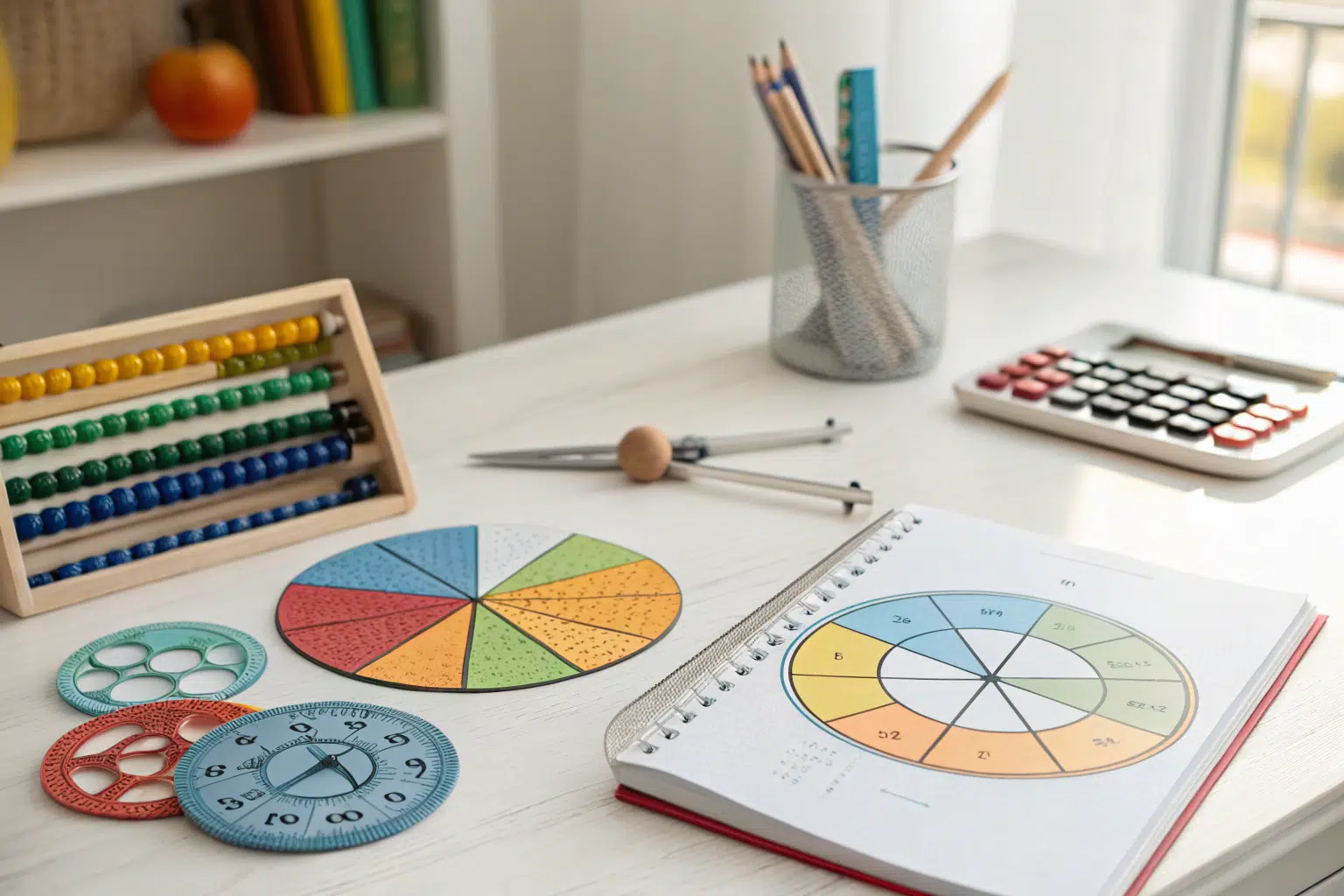
Math concepts can often appear as a formidable subject, but there’s no need for them to be intimidating. With the right guidance and approach, they can evolve into a captivating and empowering journey for adult learners. This article offers a clear roadmap to simplifying foundational mathematical ideas—including core concepts in geometry—using engaging and practical methods.
Basic math concepts are the foundational principles upon which all mathematics is built, primarily involving the four main operations: addition, subtraction, multiplication, and division. These skills are crucial for navigating daily life, forming the building blocks for advanced topics like algebra, geometry, and calculus. Many users seek to refresh these concepts to overcome math anxiety, help their children with homework, or improve job prospects, as numeracy is a key skill in many professions.
Key Benefits at a Glance
- Financial Management: Confidently create budgets, track spending, calculate sale prices, and understand interest rates.
- Everyday Efficiency: Save time and avoid errors by quickly calculating measurements for recipes, DIY projects, or travel times.
- Enhanced Problem-Solving Skills: Develop logical thinking and analytical abilities that are valuable in both personal and professional contexts.
- Foundation for Advanced Learning: Provides the solid groundwork necessary to succeed in higher-level subjects like algebra, science, and computer programming.
- Increased Career Prospects: Qualify for a wider range of jobs and promotions in fields requiring strong quantitative skills.
Purpose of this guide
This guide is designed for anyone who wants to strengthen their understanding of core mathematical principles, whether you are a student struggling with homework, a parent offering support, or an adult looking for a skills refresher. It aims to solve the common problem of feeling intimidated by numbers by breaking down the essentials into simple, manageable ideas. Here, you will learn to identify each key concept, understand its real-world application, and follow practical steps to build lasting confidence and competence, avoiding common frustrations along the way.
Why I Believe Basic Math Concepts Matter
After twenty years of teaching mathematics, I've witnessed countless students transform from math-anxious learners into confident problem-solvers. The key lies in understanding that mathematics isn't just about numbers—it's about developing the logical reasoning skills that shape how we think about the world around us.
- Mathematics forms the foundation for all logical reasoning and problem-solving skills
- Basic math concepts are essential building blocks that support advanced mathematical understanding
- Mathematical literacy directly impacts critical thinking abilities in daily life
- Strong arithmetic skills enable confident navigation of financial and practical decisions
Mathematics serves as the universal language of patterns, relationships, and logical structure. In my classroom, I've seen how students who master basic concepts develop enhanced critical thinking abilities that extend far beyond mathematical contexts. These foundational skills enable learners to approach problems systematically, break complex situations into manageable components, and evaluate solutions logically.
The connection between mathematical literacy and everyday decision-making becomes evident when students apply arithmetic skills to real-world scenarios. From calculating tips and comparing prices to understanding interest rates and managing budgets, basic math concepts empower individuals to navigate modern life with confidence and competence.
Sets and Set Theory How I Explain the Foundation of Mathematics
Set theory provides the conceptual framework upon which all mathematical structures rest. When I introduce this topic to students, I emphasize that sets are simply collections of objects that share common properties—a concept that appears everywhere in mathematics and daily life.
| Set Operation | Symbol | Description | Example |
|---|---|---|---|
| Union | ∪ | All elements in either set | A ∪ B = {1,2,3,4,5} |
| Intersection | ∩ | Elements common to both sets | A ∩ B = {3} |
| Difference | – | Elements in first set but not second | A – B = {1,2} |
| Complement | ‘ | Elements not in the set | A’ = all elements not in A |
The beauty of set theory lies in its intuitive nature. Students quickly grasp that the set of students in their math class is different from the set of students on the basketball team, yet these sets may share common elements. This understanding naturally leads to discussions about how mathematicians organize and categorize numbers, functions, and geometric objects.
Set operations mirror logical thinking processes we use constantly. When students understand union as combining groups and intersection as finding commonalities, they're developing analytical skills applicable to data analysis, computer programming, and scientific classification systems. These concepts form the foundation for understanding number systems, probability, and advanced mathematical structures.
The Foundation Numbers and Operations
“The four basic arithmetic operations in Maths, for all real numbers, are: Addition (Finding the Sum; ‘+’) Subtraction (Finding the difference; ‘-‘) Multiplication (Finding the product; ‘×’) Division (Finding the quotient; ‘÷’).”
— BYJU’S, 2024
Source link
Arithmetic forms the cornerstone of mathematical understanding, providing the computational tools necessary for all subsequent mathematical learning. These fundamental operations—addition, subtraction, multiplication, and division—serve as the building blocks from which more complex mathematical concepts emerge.
“Arithmetic Operations are the basic mathematical operations—Addition, Subtraction, Multiplication, and Division—used for calculations.”
— GeeksforGeeks, September 2025
Source link
The relationship between numbers and operations creates a mathematical ecosystem where each component supports and reinforces the others. Understanding this interconnected nature helps students see mathematics as a coherent system rather than a collection of isolated procedures.
My Approach to Teaching Number Systems
Number systems represent one of humanity's greatest intellectual achievements, providing the framework for quantifying and comparing quantities. I begin by helping students understand that numbers exist in hierarchical categories, each building upon the previous level with increased complexity and capability.
| Number Type | Definition | Examples | Properties |
|---|---|---|---|
| Natural | Counting numbers | 1, 2, 3, 4… | Positive integers starting from 1 |
| Whole | Natural numbers plus zero | 0, 1, 2, 3… | Natural numbers including zero |
| Integers | Whole numbers and negatives | …-2, -1, 0, 1, 2… | Positive and negative whole numbers |
| Rational | Numbers expressible as fractions | 1/2, 0.75, -3/4 | Can be written as p/q where q≠0 |
| Irrational | Numbers that cannot be fractions | π, √2, e | Non-repeating, non-terminating decimals |
The progression from natural numbers to real numbers tells the story of mathematical development. Natural numbers emerged from the need to count objects, while the inclusion of zero revolutionized positional notation and calculation. Negative numbers initially seemed counterintuitive but proved essential for describing debt, temperature below freezing, and directional movement.
Rational numbers extend our ability to describe parts of wholes and precise measurements, while irrational numbers reveal the mathematical richness hidden in geometric relationships. This hierarchy demonstrates how mathematical thinking evolves to meet increasingly sophisticated needs for precision and abstraction.
Addition and Subtraction How I Teach These First Operations
Addition and subtraction represent the most fundamental mathematical operations, forming the foundation for all arithmetic computation. These inverse operations work together to create a complete system for combining and separating quantities.
- Identify the operation needed based on the problem context
- Align numbers by place value when working with multi-digit numbers
- Start calculations from the rightmost column (ones place)
- Apply borrowing or carrying as needed for each column
- Check your answer using the inverse operation
The relationship between addition and subtraction illustrates a fundamental mathematical principle: every operation has an inverse that undoes its effect. This concept appears throughout mathematics, from basic arithmetic through advanced calculus, and understanding it early builds mathematical maturity.
Real-world applications of these operations appear constantly in daily life. Students add prices when shopping, subtract to find change, and use both operations in time calculations, measurement conversions, and financial planning. These practical connections help students understand that mathematics isn't abstract but deeply relevant to their experiences.
Multiplication and Division Building on the Basics in My Classroom
Multiplication and division extend arithmetic capabilities beyond simple addition and subtraction, providing efficient methods for working with repeated operations and equal groupings. These operations introduce students to more sophisticated mathematical thinking while maintaining clear connections to foundational concepts.
| Concept | Multiplication | Division |
|---|---|---|
| Basic Idea | Repeated addition | Repeated subtraction or sharing |
| Result Name | Product | Quotient |
| Key Words | Times, groups of, total | Divided by, shared among, per |
| Inverse Check | Divide product by one factor | Multiply quotient by divisor |
| Zero Property | Any number × 0 = 0 | 0 ÷ any number = 0 |
The conceptual leap from addition to multiplication represents a significant developmental milestone. Students must understand that 4 × 3 means "four groups of three" rather than simply "four plus three." This shift from sequential counting to multiplicative thinking opens doors to more advanced mathematical concepts including area, scaling, and proportional reasoning.
Division introduces the important concept of inverse operations while developing students' understanding of fairness, sharing, and rate calculations. The relationship between multiplication and division reinforces mathematical structure and provides powerful tools for checking computational accuracy.
The Power of Zero My Favorite Mathematical Revolution to Teach
Zero stands as one of the most revolutionary concepts in mathematical history, serving simultaneously as a placeholder in positional notation and as a number representing nothingness. This dual nature makes zero both intuitive and mysteriously powerful.
- Zero serves as both a placeholder (in 105) and an actual quantity (5 – 5 = 0)
- The concept of zero revolutionized mathematics and enabled positional notation
- Zero has unique properties: adding zero doesn’t change a number, multiplying by zero gives zero
- Different civilizations developed zero independently, showing its fundamental importance
The historical development of zero reveals fascinating insights into human mathematical thinking. Ancient civilizations used various systems for calculation, but the introduction of zero as both a placeholder and a number transformed mathematics from a computational tool into a sophisticated language for describing relationships and patterns.
Zero's unique properties create interesting mathematical phenomena. While adding zero leaves numbers unchanged, multiplying by zero produces zero regardless of the other factor. These properties, initially puzzling to students, demonstrate the logical consistency that makes mathematics reliable and predictable.
Order of Operations How I Make PEMDAS Stick with My Students
The order of operations establishes universal conventions for mathematical computation, ensuring that expressions have unique, unambiguous meanings. Without these agreed-upon rules, mathematical communication would be impossible and calculations would yield inconsistent results.
| Expression | Incorrect Order | Correct Order | Final Answer |
|---|---|---|---|
| 2 + 3 × 4 | (2 + 3) × 4 = 20 | 2 + (3 × 4) = 14 | 14 |
| 12 ÷ 3 + 2 | 12 ÷ (3 + 2) = 2.4 | (12 ÷ 3) + 2 = 6 | 6 |
| 2³ + 4 × 5 | (2³ + 4) × 5 = 60 | 2³ + (4 × 5) = 28 | 28 |
| (8 – 3) × 2² | 8 – (3 × 2²) = -4 | (8 – 3) × 2² = 20 | 20 |
- Parentheses – Solve expressions inside parentheses first
- Exponents – Calculate powers and roots
- Multiplication and Division – Work from left to right
- Addition and Subtraction – Work from left to right
The PEMDAS acronym (Parentheses, Exponents, Multiplication, Division, Addition, Subtraction) provides students with a memorable framework for consistent calculation. However, understanding the reasoning behind these conventions proves more valuable than memorizing the acronym alone.
These operational priorities reflect mathematical logic and efficiency. Exponents represent repeated multiplication, so they logically precede single multiplication operations. Multiplication and division, being inverse operations of equal priority, are processed from left to right, as are addition and subtraction.
Beyond the Basics How I Approach Fractions, Decimals, and Percentages
Fractions, decimals, and percentages represent three different notation systems for expressing the same fundamental concept: parts of wholes. Understanding their interconnected nature empowers students to choose the most appropriate representation for different situations while developing flexible mathematical thinking.
These representation systems each offer unique advantages in different contexts. Fractions excel at showing exact relationships and are essential for algebraic manipulation. Decimals integrate seamlessly with our base-ten number system and facilitate computation. Percentages provide intuitive understanding for comparisons and proportional relationships.
Understanding Fractions My Hands-On Approach to Parts of a Whole
Fractions represent one of the most challenging yet essential concepts in elementary mathematics. They require students to shift from thinking about whole numbers to understanding parts of wholes, a conceptual leap that demands careful pedagogical support.
| Fraction Type | Definition | Example | Key Feature |
|---|---|---|---|
| Proper | Numerator < Denominator | 3/4 | Value less than 1 |
| Improper | Numerator ≥ Denominator | 7/4 | Value greater than or equal to 1 |
| Mixed Number | Whole number + proper fraction | 1 3/4 | Combination form |
| Unit Fraction | Numerator equals 1 | 1/5 | One part of the whole |
The key to successful fraction instruction lies in connecting abstract symbols to concrete experiences. I use physical manipulatives like fraction circles, bars, and tiles to help students visualize how fractions represent actual quantities. This hands-on approach builds conceptual understanding before introducing computational procedures.
Understanding equivalent fractions forms the foundation for all fraction operations. Students must grasp that 1/2, 2/4, and 3/6 represent the same quantity despite having different numerators and denominators. This concept prepares students for adding fractions with different denominators and simplifying complex fraction expressions.
Decimals How I Connect Them to Fractions for Better Understanding
Decimals extend our place-value system to represent fractional quantities using powers of ten. This connection to familiar base-ten notation makes decimals particularly accessible while maintaining precision in calculation and measurement.
| Fraction | Decimal | Percentage | Description |
|---|---|---|---|
| 1/2 | 0.5 | 50% | One half |
| 1/4 | 0.25 | 25% | One quarter |
| 3/4 | 0.75 | 75% | Three quarters |
| 1/10 | 0.1 | 10% | One tenth |
| 1/100 | 0.01 | 1% | One hundredth |
The relationship between fractions and decimals becomes clear when students understand that decimal places represent denominators that are powers of ten. The decimal 0.7 equals 7/10, while 0.35 equals 35/100, demonstrating how decimal notation provides a standardized way to express fractional quantities.
Converting between fractions and decimals develops number sense and computational flexibility. Students learn that some fractions convert to terminating decimals (1/4 = 0.25) while others produce repeating decimals (1/3 = 0.333…), introducing them to the rich mathematical relationship between rational and decimal representations.
Percentages My Triangle Technique for Understanding Parts per Hundred
Percentages provide an intuitive framework for understanding proportional relationships by standardizing all comparisons to parts per hundred. This consistency makes percentages particularly powerful for comparing quantities of different sizes.
- Draw a triangle with ‘Percentage’ at the top, ‘Part’ bottom left, ‘Whole’ bottom right
- Cover the unknown value you want to find
- Use the remaining two values with the operation shown by their position
- If values are side by side, multiply them; if one is above the other, divide
- Apply the calculation to solve for the unknown percentage, part, or whole
My triangle technique provides students with a visual tool for organizing percentage problems and determining appropriate operations. This method eliminates confusion about whether to multiply or divide, empowering students to solve percentage problems systematically and confidently.
Real-world applications of percentages appear everywhere: sales discounts, tax calculations, tip amounts, interest rates, and statistical data. These practical connections help students understand that percentages aren't just academic exercises but essential tools for navigating modern life effectively.
Prime Numbers How I Present the Building Blocks of Integers
Prime numbers represent the fundamental building blocks of the integer system, serving as mathematical "atoms" from which all other integers can be constructed through multiplication. This concept introduces students to the elegant structure underlying number theory.
Prime numbers aren’t just theoretical—they’re essential in modern cryptography, including simple XOR-based encoding. For a hands-on example, explore how Python’s XOR operator can create lightweight ciphers where prime-based keys add extra security layers.
- 2 is the only even prime number (all other even numbers are divisible by 2)
- There are infinitely many prime numbers, as proven by Euclid over 2000 years ago
- Prime numbers become less frequent as numbers get larger, but never disappear entirely
- Every integer greater than 1 can be expressed as a unique product of prime numbers
The uniqueness of prime factorization reveals deep mathematical structure. Just as chemists understand that water molecules always contain exactly two hydrogen atoms and one oxygen atom, mathematicians know that every integer has exactly one prime factorization. This fundamental theorem of arithmetic underlies many advanced mathematical concepts.
Prime numbers also connect to practical applications in computer science, particularly in cryptography and data security. The difficulty of factoring large numbers into their prime components forms the basis for many encryption systems that protect online communications and financial transactions.
Practical Applications How I Apply Math in Everyday Life
Basic math concepts center on core operations like addition, subtraction, multiplication, and division, forming the foundation for all numerical work. These enable everyday tasks from budgeting to problem-solving. Explore number systems for deeper insights into properties and applications.
Mathematics permeates daily life in ways both obvious and subtle. From calculating tips and comparing prices to understanding loan terms and interpreting statistical claims, mathematical literacy empowers informed decision-making and critical evaluation of quantitative information.
Financial Literacy How I Use Math for Budgeting and Interest
Financial mathematics applies basic arithmetic operations to money management, investment decisions, and economic planning. Understanding these applications empowers individuals to make informed financial choices and avoid costly mistakes.
| Interest Type | Calculation | Example (5% for 3 years) | Final Amount |
|---|---|---|---|
| Simple Interest | Principal × Rate × Time | $1000 × 0.05 × 3 = $150 | $1150 |
| Compound Interest | Principal × (1 + Rate)^Time | $1000 × (1.05)³ = $157.63 | $1157.63 |
| Monthly Compounding | Principal × (1 + Rate/12)^(12×Time) | $1000 × (1.004167)³⁶ = $161.62 | $1161.62 |
The difference between simple and compound interest illustrates the power of mathematical understanding in financial planning. While simple interest grows linearly, compound interest grows exponentially, creating dramatically different outcomes over time. Understanding this distinction helps individuals make better decisions about savings, investments, and loans.
Budgeting requires percentage calculations, proportion reasoning, and basic arithmetic operations. Students who master these skills can create realistic budgets, track spending patterns, and make informed decisions about financial priorities and goals.
Measurement and Cooking My Kitchen Laboratory for Teaching Proportions
Cooking provides an ideal context for teaching measurement, conversion, and proportional reasoning. Recipe scaling, unit conversion, and ingredient substitution all require mathematical thinking applied to familiar, practical situations.
- Identify the original recipe serving size and desired serving size
- Calculate the scaling factor by dividing desired servings by original servings
- Multiply each ingredient quantity by the scaling factor
- Convert measurements to appropriate units (e.g., 1.5 cups = 1 cup + 1/2 cup)
- Double-check calculations, especially for critical ingredients like baking powder
Recipe scaling demonstrates proportional reasoning in action. When doubling a recipe, students learn that all ingredients must be scaled by the same factor to maintain proper ratios and achieve desired results. This concept transfers to many other contexts, from mixing paint colors to calculating medication dosages.
Measurement conversion between different unit systems develops students' understanding of equivalent quantities and proportional relationships. Converting between cups and ounces, teaspoons and tablespoons, or Fahrenheit and Celsius requires mathematical thinking that extends far beyond the kitchen.
Time and Distance How I Make Motion Math Relevant
Time and distance calculations provide concrete applications for basic arithmetic operations while developing students' understanding of rates, ratios, and proportional relationships. These concepts appear in travel planning, sports analysis, and scientific measurement.
- Distance = Speed × Time (D = S × T)
- Speed = Distance ÷ Time (S = D ÷ T)
- Time = Distance ÷ Speed (T = D ÷ S)
- Average Speed = Total Distance ÷ Total Time
- Remember to keep units consistent (miles/hour, kilometers/hour, etc.)
These fundamental relationships demonstrate how mathematical formulas capture real-world patterns and enable practical problem-solving. Students learn to identify which quantities they know and which they need to find, then apply appropriate formulas to solve problems systematically.
Understanding rates and ratios through motion problems prepares students for more advanced concepts in physics, engineering, and economics. The ability to work with proportional relationships forms the foundation for understanding linear functions, scaling, and many other mathematical concepts.
Visual Mathematics How I Represent Data and Concepts
Visual representation transforms abstract mathematical concepts into concrete, accessible forms that enhance understanding and reveal patterns invisible in purely numerical formats. Effective visualization bridges the gap between mathematical abstraction and intuitive comprehension.
Visual aids serve multiple purposes in mathematical education: they make abstract concepts tangible, reveal relationships between different mathematical ideas, and provide alternative pathways for understanding when traditional approaches prove challenging for individual learners.
Graphs and Charts My Approach to Making Numbers Visual
Data visualization transforms numerical information into graphical formats that reveal patterns, trends, and relationships more clearly than raw numbers alone. Different chart types serve specific purposes and emphasize different aspects of data.
| Chart Type | Best Used For | Example Data | Key Advantage |
|---|---|---|---|
| Bar Chart | Comparing categories | Sales by month | Easy comparison of discrete values |
| Line Graph | Showing trends over time | Temperature changes | Clear visualization of patterns |
| Pie Chart | Showing parts of a whole | Budget breakdown | Immediate sense of proportions |
| Scatter Plot | Showing relationships | Height vs. weight | Reveals correlations between variables |
Choosing appropriate visualization methods requires understanding both the data type and the story you want to tell. Bar charts excel at comparing discrete categories, while line graphs highlight trends and changes over time. Pie charts effectively show proportional relationships, and scatter plots reveal correlations between variables.
The process of creating graphs and charts develops students' analytical thinking skills. They must organize data, choose appropriate scales, label axes clearly, and interpret the resulting visual patterns. These skills transfer to scientific research, business analysis, and many other fields requiring data interpretation.
The Cartesian Coordinate System How I Connect Algebra and Geometry
The Cartesian coordinate system, developed by René Descartes, revolutionized mathematics by providing a bridge between algebraic equations and geometric shapes. This innovation enables visualization of algebraic relationships and algebraic analysis of geometric problems.
- Start at the origin (0,0) where the x and y axes intersect
- Move horizontally along the x-axis according to the first coordinate
- From that position, move vertically according to the second coordinate
- Mark the point where you end up
- Remember: positive x goes right, negative x goes left; positive y goes up, negative y goes down
The coordinate system transforms abstract algebraic equations into visual patterns that students can see and manipulate. Linear equations become straight lines, quadratic equations form parabolas, and systems of equations reveal their solutions as intersection points.
This visual-algebraic connection empowers students to understand mathematical relationships more deeply. They can see how changing coefficients in equations affects the shapes and positions of graphs, developing intuitive understanding of mathematical relationships that supports more advanced study in calculus and beyond.
Geometric Shapes My Hands-On Approach to Math in Space
Geometry introduces students to spatial reasoning and measurement concepts that appear throughout mathematics and practical applications. Understanding shapes, their properties, and measurement formulas develops both mathematical thinking and practical problem-solving skills.
| Shape | Dimensions | Area/Volume Formula | Real-World Example |
|---|---|---|---|
| Square | 2D | A = s² | Floor tile |
| Circle | 2D | A = πr² | Pizza |
| Triangle | 2D | A = ½bh | Roof section |
| Cube | 3D | V = s³ | Dice |
| Sphere | 3D | V = (4/3)πr³ | Basketball |
| Cylinder | 3D | V = πr²h | Soup can |
Connecting geometric formulas to real-world objects helps students understand practical applications while developing spatial visualization skills. Calculating the area of a garden plot, the volume of a storage container, or the amount of paint needed for a wall demonstrates how geometric concepts solve practical problems.
Hands-on activities with physical shapes, measuring tools, and construction materials make abstract geometric concepts concrete and memorable. Students who struggle with algebraic manipulation often excel when working with geometric relationships, providing alternative pathways to mathematical understanding.
Building Problem-Solving Skills Through My Math Teaching
Problem-solving represents the ultimate goal of mathematical education: the ability to apply mathematical knowledge and reasoning to unfamiliar situations. Systematic problem-solving strategies empower students to approach challenges with confidence and persistence.
Effective problem-solving combines mathematical knowledge with strategic thinking, persistence, and metacognitive awareness. Students must learn not only mathematical procedures but also how to analyze problems, choose appropriate strategies, and evaluate their solutions.
How I Break Down Word Problems for My Students
Word problems challenge students to translate verbal descriptions into mathematical expressions and operations. This translation skill bridges everyday language and mathematical thinking while developing reading comprehension and analytical reasoning abilities.
- Read the problem carefully and identify what you’re asked to find
- Highlight or underline the important numbers and key words
- Determine what operation(s) you need to use based on the context
- Set up the mathematical expression or equation
- Solve the problem step by step
- Check if your answer makes sense in the context of the problem
The key to successful word problem solving lies in systematic analysis rather than rushing toward calculation. Students must learn to identify relevant information, ignore distracting details, and recognize the mathematical relationships described in verbal format.
Common word problem patterns help students recognize familiar structures in unfamiliar contexts. Addition problems often involve combining quantities, subtraction problems frequently describe finding differences or remaining amounts, and multiplication problems typically involve repeated groups or rate calculations.
Pattern Recognition How I Develop Algebraic Thinking
Pattern recognition forms the bridge between arithmetic calculation and algebraic reasoning. Students who can identify, extend, and describe patterns develop the analytical thinking skills necessary for understanding variables, functions, and algebraic relationships.
- Look for what stays the same and what changes in number sequences
- Try adding, subtracting, multiplying, or dividing to find the pattern rule
- Use variables to represent unknown values in patterns
- Create tables to organize pattern data and spot relationships
- Practice extending patterns both forward and backward to test understanding
Mathematical patterns appear everywhere: in number sequences, geometric arrangements, and functional relationships. Students who learn to recognize these patterns develop mathematical intuition that supports understanding of more advanced concepts including functions, equations, and mathematical modeling.
The transition from specific numerical examples to general algebraic expressions represents a crucial developmental milestone. Students must learn to see that the pattern 2, 4, 6, 8… can be described generally as 2n, where n represents the position in the sequence.
Functions How I Explain Mathematical Machines
Functions represent one of the most important concepts in mathematics, providing a framework for understanding relationships between quantities. The machine metaphor helps students visualize how functions transform inputs into outputs according to specific rules.
Once students grasp mathematical functions, they’re primed to understand programming functions. I often bridge this by showing how the same input-output logic applies in languages like JavaScript, as detailed in our roadmap for learning JavaScript.
| Input | Function Rule | Output | Description |
|---|---|---|---|
| 3 | Add 5 | 8 | f(x) = x + 5 |
| 4 | Multiply by 2 | 8 | f(x) = 2x |
| 5 | Square the number | 25 | f(x) = x² |
| 6 | Subtract 1, then double | 10 | f(x) = 2(x – 1) |
The function machine metaphor makes abstract mathematical relationships concrete and understandable. Students can visualize putting a number into the machine, applying the function rule, and receiving the transformed output. This visualization supports understanding of more complex functional relationships.
Functions model real-world relationships between quantities: the relationship between hours worked and wages earned, between distance traveled and time elapsed, or between temperature in Celsius and Fahrenheit. These practical connections demonstrate how mathematical abstractions capture and describe real phenomena.
My Approach to Teaching Infinity and the Number Line
Infinity challenges students' intuitive understanding of quantity and number, introducing them to mathematical concepts that extend beyond everyday experience. The number line provides a visual framework for understanding both finite and infinite mathematical concepts.
The concept of infinity appears in multiple mathematical contexts: the endless sequence of natural numbers, the infinite density of points on a line segment, and the limitless precision of decimal representations. Each context requires different approaches to understanding and visualization.
Understanding infinity develops students' capacity for abstract thinking while challenging common misconceptions about mathematical limits and boundaries. The realization that there are infinitely many numbers between any two points on the number line reveals the mathematical richness hidden in seemingly simple concepts.
Imaginary Numbers How I Make the Abstract Concrete
Imaginary numbers extend the number system beyond real quantities to include solutions to equations that have no real solutions. Despite their name, imaginary numbers have concrete applications in engineering, physics, and advanced mathematics.
The development of imaginary numbers demonstrates how mathematical thinking evolves to address new problems and challenges. When mathematicians encountered equations like x² = -1, they created new mathematical objects rather than declaring such equations unsolvable.
Complex numbers, which combine real and imaginary components, provide a complete number system that includes solutions to all polynomial equations. This completeness makes complex numbers essential for advanced mathematics, electrical engineering, and quantum physics.
Strategies I've Developed for Learning and Retaining Math Concepts
Effective mathematical learning requires more than exposure to concepts and procedures; it demands strategic approaches that promote deep understanding, long-term retention, and flexible application. Research-based learning strategies significantly improve mathematical achievement and confidence.
Successful mathematics students develop metacognitive awareness about their learning processes, recognizing which strategies work best for different types of mathematical content and adjusting their approaches based on feedback and results.
My Active Learning Techniques for Mathematics
Active learning engages students as participants in the learning process rather than passive recipients of information. Mathematical understanding develops through doing, explaining, and connecting concepts rather than simply watching demonstrations or memorizing procedures.
- DO: Explain concepts out loud to yourself or others
- DO: Work through problems step-by-step without looking at solutions first
- DO: Create your own examples to test understanding
- DON’T: Just re-read notes passively without practicing
- DON’T: Skip steps when working through problems
- DON’T: Memorize procedures without understanding the reasoning
Active learning strategies transform students from passive consumers of mathematical information into active constructors of mathematical understanding. When students explain concepts to others, create their own examples, or solve problems without immediately consulting solutions, they develop deeper comprehension and stronger retention.
The process of articulating mathematical reasoning reveals gaps in understanding and strengthens neural pathways associated with mathematical concepts. Students who regularly explain their thinking develop better problem-solving skills and mathematical communication abilities.
How I Help Students Overcome Math Anxiety
Math anxiety represents a significant barrier to mathematical learning, creating emotional and cognitive interference that impairs performance regardless of actual mathematical ability. Addressing math anxiety requires both psychological and pedagogical interventions.
- Start with problems slightly below your comfort level to build confidence
- Focus on understanding the process rather than getting the ‘right’ answer immediately
- Use positive self-talk: replace ‘I can’t do this’ with ‘I can’t do this yet’
- Break complex problems into smaller, manageable steps
- Celebrate small victories and progress rather than only final outcomes
Growth mindset interventions help students understand that mathematical ability develops through effort and practice rather than being fixed at birth. Students who believe they can improve their mathematical skills through persistence and appropriate strategies show greater resilience and achievement.
Creating positive mathematical experiences builds confidence and motivation while reducing anxiety. When students experience success through appropriate challenge levels and supportive feedback, they develop positive associations with mathematical learning that support continued growth.
My Proven Practice Routines for Math Mastery
Systematic practice routines based on cognitive science principles optimize learning efficiency and retention. Spaced repetition, interleaved practice, and deliberate practice strategies significantly improve mathematical skill development.
| Age Group | Daily Practice Time | Focus Areas | Review Schedule |
|---|---|---|---|
| Elementary (6-10) | 15-20 minutes | Basic operations, number sense | Review previous day’s work |
| Middle School (11-13) | 20-30 minutes | Fractions, decimals, pre-algebra | Review weekly concepts |
| High School (14-18) | 30-45 minutes | Algebra, geometry, advanced topics | Monthly comprehensive review |
| Adult Learners | 20-40 minutes | Practical applications, targeted gaps | Flexible based on goals |
Effective practice routines balance new learning with review of previously mastered concepts. Spaced repetition ensures that skills remain accessible over time, while interleaved practice develops flexible thinking and prevents over-reliance on recently practiced procedures.
The quality of practice matters more than quantity alone. Deliberate practice focuses attention on specific skills, provides immediate feedback, and gradually increases challenge levels to maintain optimal learning conditions. Students who engage in deliberate practice show faster skill development and better long-term retention than those who simply repeat familiar procedures.
Frequently Asked Questions
The basic concepts of math include numbers and counting, arithmetic operations like addition and subtraction, geometry with shapes and space, and measurement for quantifying real-world objects. These foundational ideas form the building blocks for more advanced topics and are essential for problem-solving in daily life. Understanding them helps in tasks ranging from budgeting to figuring out how to measure waist for men when tailoring clothes.
Every child should know fundamental concepts like counting, basic arithmetic operations (addition, subtraction, multiplication, and division), understanding fractions and decimals, and simple geometry such as identifying shapes. These skills build number sense and logical thinking, preparing them for real-life applications. Mastering them early also aids in practical scenarios, like learning how to measure waist for men in clothing sizing.
Improving basic math skills involves consistent practice through worksheets, online apps, or games that reinforce concepts like addition and multiplication. Seeking help from tutors or joining study groups can provide personalized guidance and motivation. Applying math to everyday tasks, such as calculating how to measure waist for men for fitness tracking, makes learning engaging and relevant.
Basic math concepts show up in daily tasks like budgeting expenses using addition and subtraction, cooking with fractions for recipes, or shopping with percentages for discounts. Measurement skills are crucial for activities such as determining how to measure waist for men when buying pants or belts. These applications make abstract ideas concrete and demonstrate math’s practical value in real life.
The order of operations, often remembered by PEMDAS (Parentheses, Exponents, Multiplication and Division, Addition and Subtraction), dictates the sequence for solving mathematical expressions to ensure consistent results. It’s important because it prevents ambiguity in calculations, allowing everyone to arrive at the same answer. This concept applies to practical scenarios, like using formulas to figure out how to measure waist for men in health assessments.